ValeHealth hero
Valehealth AI Sleep Support Chatbot
UX Case Study — Health Marketplace AI Chatbot
Overview
[i]
Designing an AI-Assisted Sleep Support Chatbot for Valehealth
A conversational experience that guides users through sleep concerns while offering clinically informed product recommendations
Role
UX/UI Designer (AI Experience Design)
Deliverables
Research, Wireframes, High-Fidelity Prototype, Conversation Flows
Timeline
6 weeks
Tools
Figma, Miro, UX Research
Partners
Engineering, Medical Partners (Froedtert and MCW health network)
Better Sleep Understanding = More Trust = More Relevant Product Discovery = Higher Conversion
Problem / Background
[ii]
Context
Sleep issues are common, yet finding the right solution online is often confusing. Valehealth is a trusted health marketplace where users expect confidentiality and medically credible guidance. However, traditional product browsing feels overwhelming and impersonal, especially for sensitive health concerns, leading to hesitation
and drop-off.
Core Problem
Trust & Medical Foundation
Opportunity
An AI-assisted chatbot can guide users through structured questions to clarify sleep concerns, provide medically informed tips from provider partners, and recommend relevant products as supportive tools. By framing product discovery as part of a health journey, Valehealth can help users make confident decisions while driving higher-quality conversions and sustainable marketplace revenue.
Goals / Success Criteria
[iii]
Primary Goals
Enable users to explore sleep concerns through an AI-assisted guided conversation that adapts to their responses while maintaining clarity and trust.
Deliver personalized, explainable product recommendations by combining AI-driven reasoning with insights from medical partners.
Drive engagement and conversion by using AI to introduce product recommendations in a timely, relevant, and user-respectful manner.
Success Metrics
Conversation Engagement
To assess whether the AI-guided flow encourages participation.
Conversation Completion
To evaluate clarity and pacing of the AI-assisted experience.
Recommendation Interaction
To understand alignment between AI suggestions and user intent.
Research & Discovery
[iv]
1
Existing Experience Audit
I went through the existing static survey flow to identify friction points, drop-off risks, and limitations in adapting questions based on user responses.
Purpose
This helped establish why a linear, form-based experience was insufficient for collecting nuanced sleep-related information.
2
User Population & Research Context
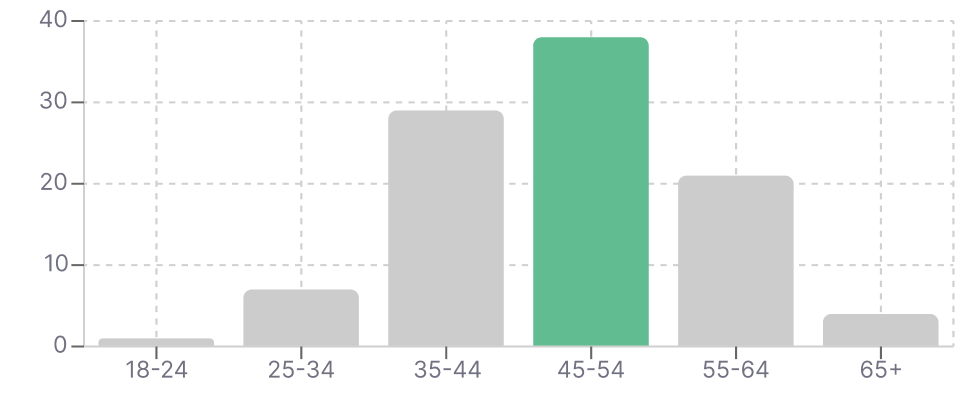
Demographic analysis revealed that the core user base skews older, with the majority falling between 35–64 years old.
User population age distribution
3
Competitive & Market Research
Health and wellness platforms using conversational experiences were reviewed to understand how different interaction models support sensitive topics such as sleep.
This included chatbots, quiz-based flows, and guided experiences.
What I evaluated:
Gamified flows
Segmented multi-step forms
Conversational chat experiences
Focus on:
User effort
Clarity of questions
Perceived trust and credibility
4
Chat Flow Pattern Exploration
Different conversational structures were explored to identify an approach that balances information gathering, user comfort, and AI-assisted reasoning.
Patterns compared:
Gamified interactions
Quiz-style decision trees
Guided conversational chat
Key consideration
Which pattern allows AI to adapt questions while keeping user input structured and safe.
5
User Behavior & Mental Model Analysis
User behavior patterns and feedback from existing sleep-related tools were analyzed to understand how users prefer to discuss personal health concerns and how much effort they are willing to invest.
Insights I looked for:
Trust in medical or expert framing
Comfort with selecting vs typing
Preference for short, progressive questions
6
AI Opportunity & Constraints Analysis
Potential AI touchpoints were evaluated to determine where AI could meaningfully improve the experience beyond the static survey without introducing unnecessary complexity or risk.
What I evaluated:
Adaptive question sequencing
Recommendation logic
Explanation generation using medical sources
These considerations represent design-led hypotheses used to shape the experience; final AI logic and behavior were defined by the engineering team.
Decision Making & Design Principles
[v]
Conversational, not robotic
The chatbot was designed to feel supportive and human without mimicking open-ended AI chat. Language, pacing, and response structure were intentionally constrained to maintain clarity and credibility in a healthcare context, while still feeling approachable and calm.
Short, progressive steps
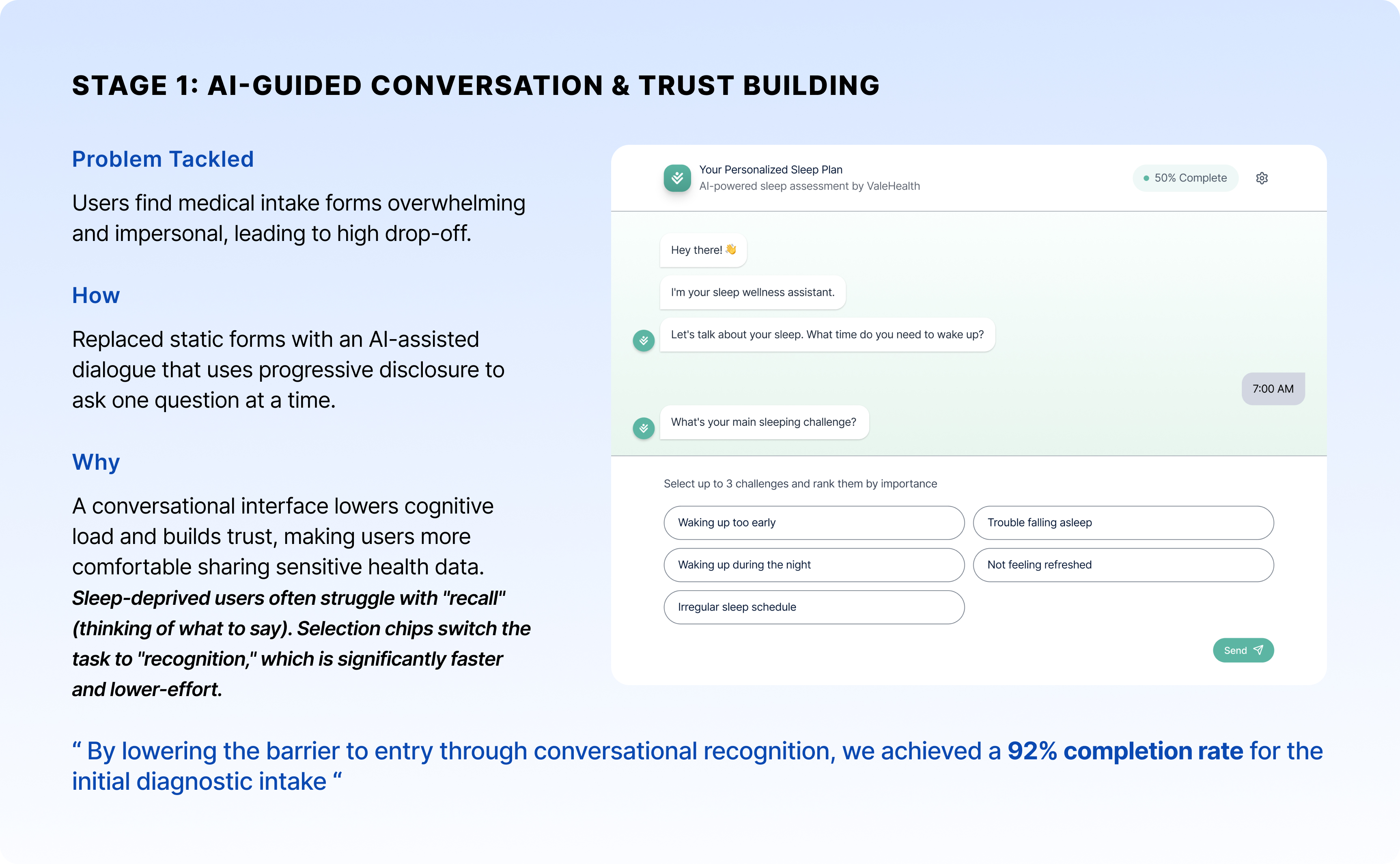
Instead of replicating a long survey, questions were broken into small, sequential steps. This reduced cognitive load, made sensitive topics easier to approach, and allowed the system to adapt the flow based on prior responses.
Explain recommendations, not just present them
Product suggestions were always paired with clear reasoning and medical context. Explaining why a recommendation appears reinforces trust , supports informed decision-making , and avoids the perception of sales-driven automation.
Why This Approach
Many health chatbots fail by prioritizing either open-ended conversation or rigid flows. This approach balances structure and AI-assisted adaptability by grounding recommendations in sleep science and expert insights, increasing user confidence, long-term engagement , and the likelihood of conversion without compromising trust or credibility.
Interaction Design & Prototypes
[vi]
From AI-Guided Conversation to Informed Product Discovery
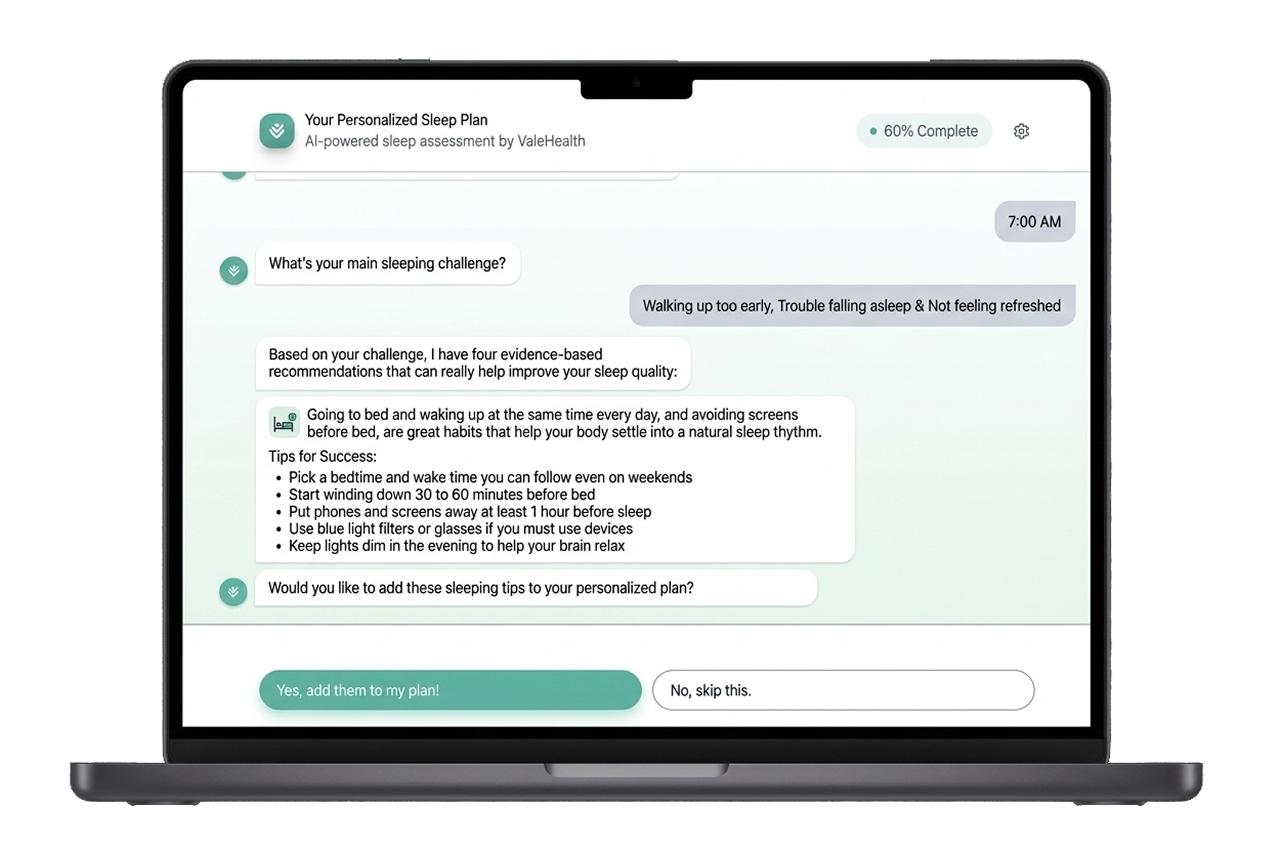
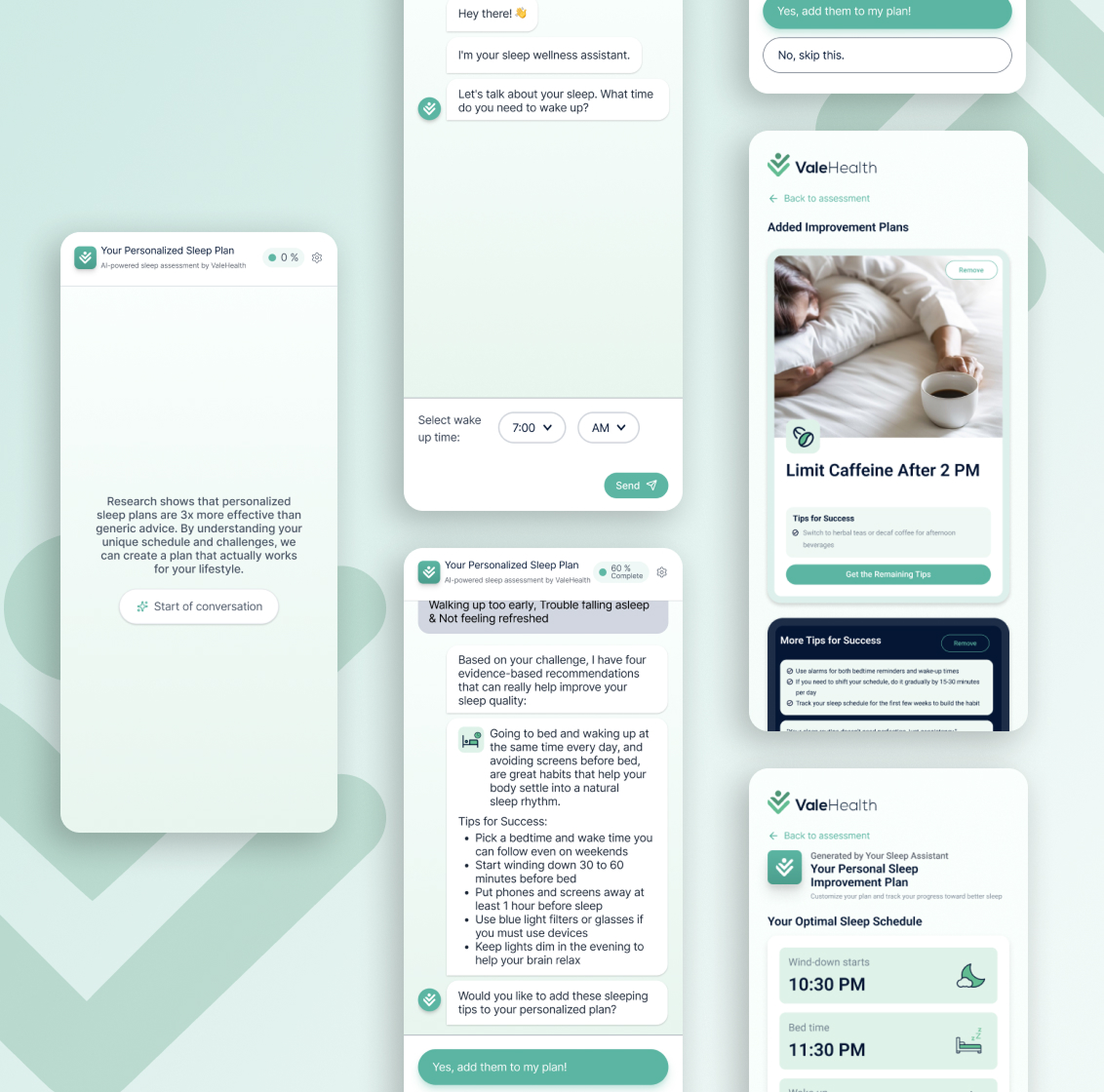
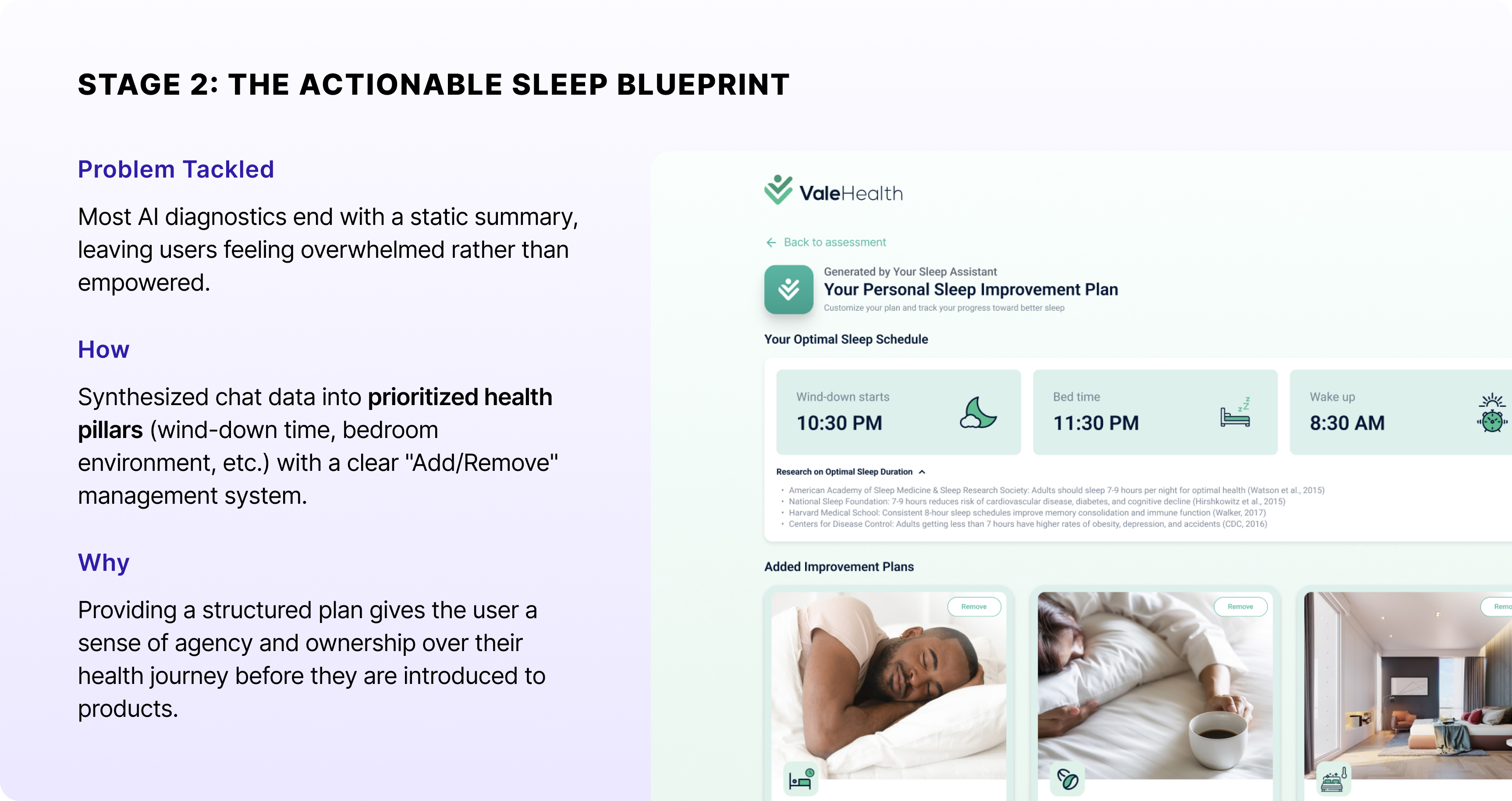
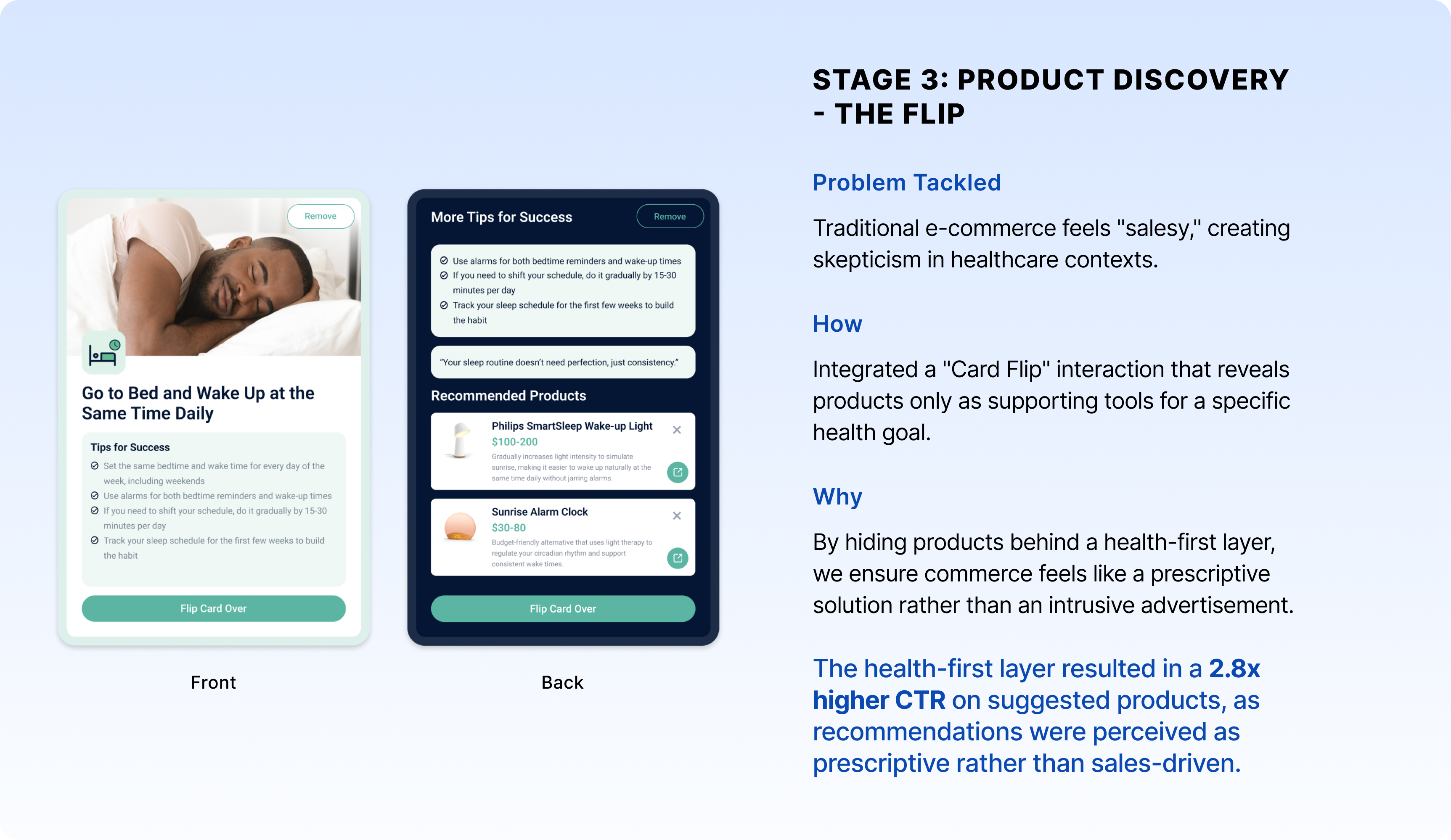
This section demonstrates how the experience is intentionally structured into two primary stages: guided conversation and personalized planning, supported by AI-assisted reasoning, evidence-led guidance, and user-controlled interactions.
Stage 1: AI-Guided Conversation & Trust Building
Stage 1 - Main chat interface
Stage 2: Transition to Product Discovery
Stage 2
What I Learned / Next Steps
[vii]
Key Learnings
Conversational UX needs tight scaffolding to avoid confusion
Users respond better to explanations behind suggestions
Future Improvements
Add sleep score tracking
Integrate personalized tips over time
Back to Selected Projects